

Today, the artist stands at the exhibition’s entrance wearing a blouse and black trousers, taking in a survey of her work that spans her early pandemic-era paintings to her most recent pared-back watercolors in which her subjects appear in muted hues floating in white negative space. “It’s a historical idea,” says McKinney as she pauses to assess her works gathered on the museum’s freshly painted powder blue walls, “having these beautiful Black women here and reclaiming their space, especially in New Orleans, but also reclaiming the idea of rest in the South, where there is a ‘work, do, go,’ mentality.”
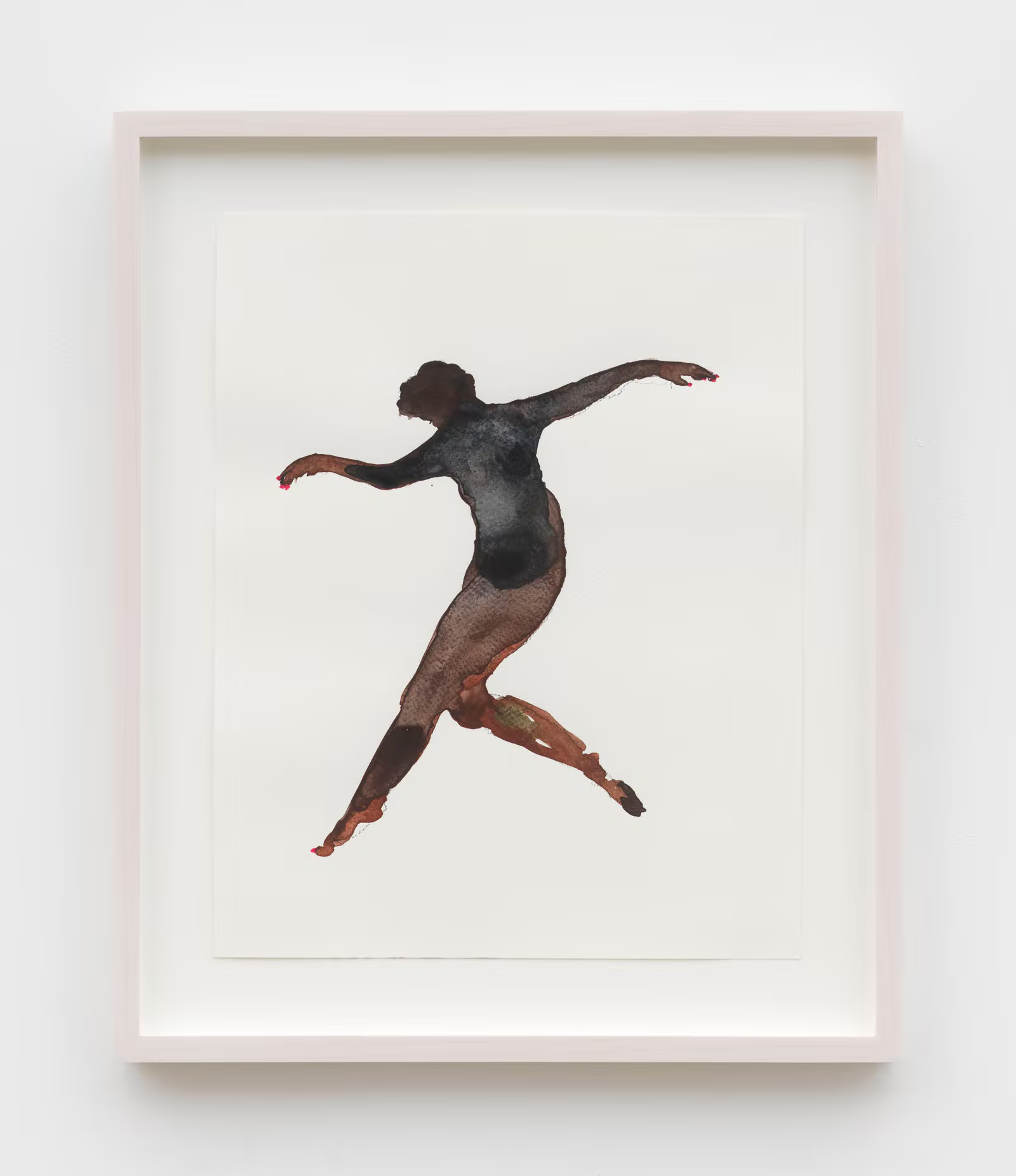
Danielle Mckinney, Landslide, 2025. Photography by Pierre Le Hors.
Image courtesy of the artist, Marianne Boesky Gallery, and Galerie Max Hetzler.
The historical Creole capital suits these elegant women well; they lean back in repose, cigarettes dangling from their red nails, no cell phones or computers in sight. Hair worn natural, clothes stylishly, they radiate a sense of peace from rooms of their own. “What does that mean to pause, and also to be looked upon?” McKinney asks, adding, “a lot of the ladies are okay with being seen.” In Nighthawk, 2025, one woman leans back in a wooden chair, her oversized lime-green fur coat draped off her shoulders over a patterned pajama set; her features softly rendered in gestural strokes, highlighted with pops of blue and pink. The colors are sumptuous, the backdrop moody. It’s only a corner of the subject’s world, but she seems content to stay there a while. In Esther, made the same year, another appears in situ with a high-ceilinged space, paintings on the walls, a fireplace and two armchairs; wearing only a robe, legs crossed, she leans back in golden hour. It’s a scene as aspirational as it is relatable.
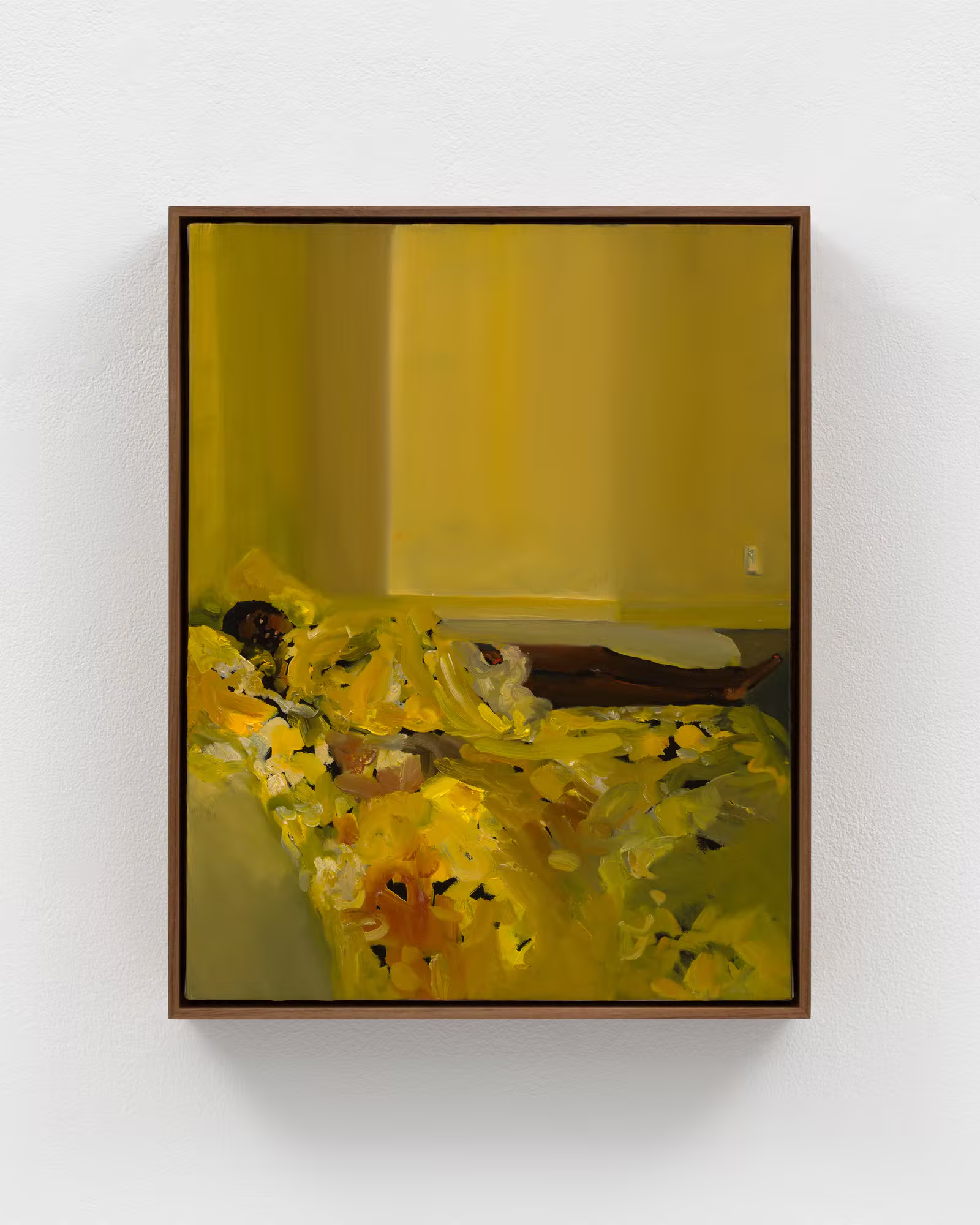
Danielle Mckinney, Yesterday, 2025. Photography by Pierre Le Hors.
Image courtesy of the artist, Marianne Boesky Gallery, and Galerie Max Hetzler.
I wonder, with all her recent success, has the meaning, and even possibility of rest, shifted for McKinney? “They are a reminder,” she says, looking out at the paintings. “It took me almost five years to embody them and say, ‘I need to pause, I need to stop.’ And when I stop, I'm actually able to make better work.” Painting has become a practice of slowing down, and it has trickled into her day to day life, too. In person, McKinney is warm and present. “I just try to be myself,” she says, an introvert who shows up fully and then goes home to recharge, often finding time to sit in her armchair in her plant-filled studio in Jersey City and meditate in the natural light. “Sometimes it’s like, I got to get out of here, got to get out of here,” she says of living in a metropolis. “But you can build your sanctuary wherever you are.”
As we walk through the exhibition, McKinney lets me in on a secret: Before she began this style of individual portraiture, she would realize a second figure, a man who she was in a relationship with throughout the late 2010s. During the pandemic, processing the partnership, and her place in and out of it, became the catalyst to develop her painterly practice (she initially had trained as a photographer and worked in architecture). Once she separated from her lover, so did her ladies. McKinney points to We Need to Talk, 2020, in which a figure in a big yellow fur coat and seemingly nothing else but neon teal tights and a cigarette in hand, sits with her eyes closed, as if she is defrosting into the woman she wants to be. She started the work before her separation, while she was still pregnant with her now 5-year-old daughter; its subject possesses a sense of carefree freedom, and McKinney painted her way into it.
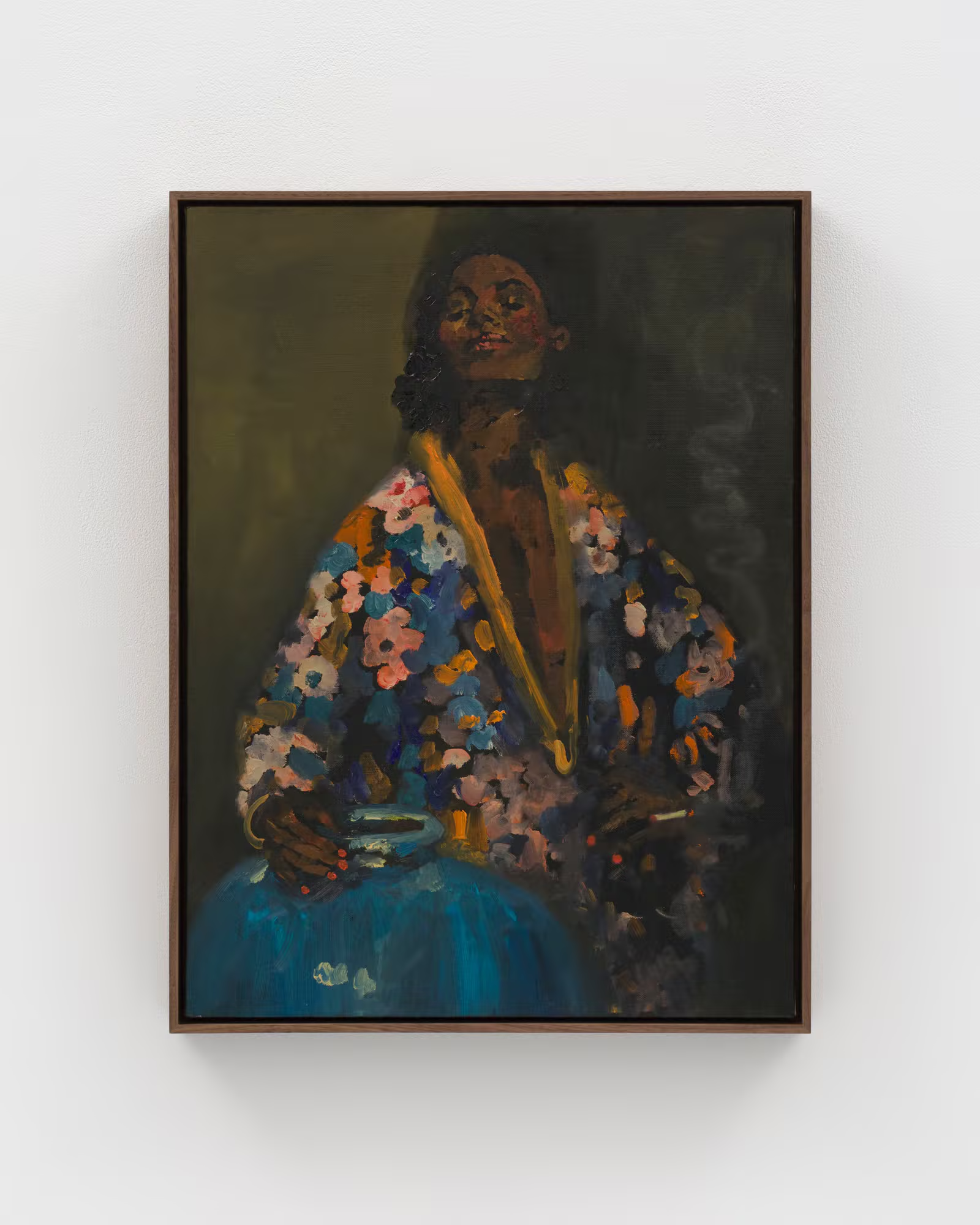
Danielle Mckinney, She, 2023. Photography by Pierre Le Hors.
Image courtesy of the artist, Marianne Boesky Gallery, and Galerie Max Hetzler.
“It's still this mood and this woman that I'm so fascinated with, and she just repeats,” says McKinney half a decade later. Her figures are central in their own narratives, commanding rooms alone, save for the animals, which the artist sees as universal embodiments of sharing space. A nude woman rides a horse, bareback, into a green abyss in Haste, 2021. A butterfly perches on another’s finger in Shelter, 2023, as she gazes out against a buttery yellow backdrop. A pair of hands release a dove in Veil, 2023. Each figure is a stand-in for the viewer more broadly speaking, but it's her grandmother, her mother, and her aunt that she paints with in mind. “We didn't have anything when I grew up, but we had a home,” McKinney says of her upbringing in Montgomery, Alabama. “And my mom made that home special with music and peace.”
It’s full circle for McKinney, who recalls how she began painting sanctuaries of her own during grad school: “I was so bogged down with conceptual dogma,” she says. There was the added frustration of going into galleries and art institutions and not seeing Black bodies represented. McKinney traces this back to a similar feeling she had as a child, cutting out photos from magazines to glue onto shoebox dollhouses. “I would get so frustrated that I could never cut out a Black woman. I could never insert my doll as a Black doll,” she says. As McKinney began to take painting seriously, she returned to what she loved: “I was like, Maybe I'm fusing my love for sanctuary, my desire to be seen, all in this subconscious energy.” Today, she reflects on how she is finally able to see her likeness in those very spaces she once felt left out from; she still gets emotional when she walks into a museum and sees one of her ladies on the wall: “I'm like, You’re here!”
