

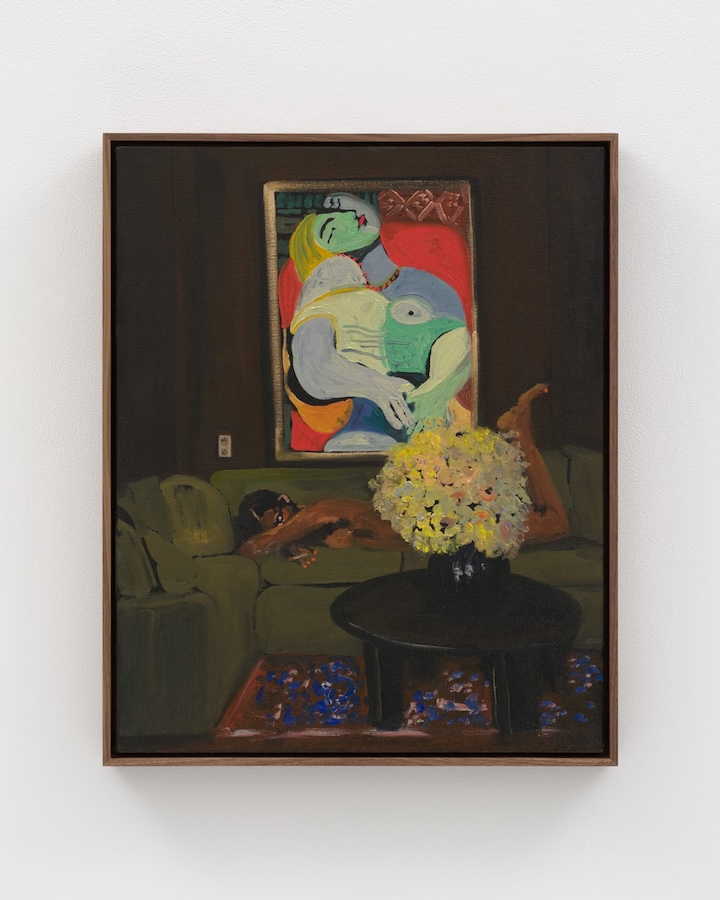
Above my sofa hangs a print of Danielle Mckinney’s Sandman. In it, a nude Black woman reclines across a couch, her arms folded under her half-covered head. A cigarette balances loosely between her limp fingers, a central motif to many of Mckinney’s works. The mood is quiet. Dark mahogany walls. An olive green sofa. A shadowless black vase almost indistinguishable from the table it sits upon, filled with pastel flowers that conceal the lower half of our sleepy lady’s body. Above her repose hangs Mckinney’s rendition of Picasso’s Le Rêve, a cubist painting of his once-young mistress in slumber, as though it were the dream unfolding behind her closed eyes. The vivid colors in Le Rêve hover like an invisible thought bubble, the mistress’s lavender breast peeking out of a mint green blouse, a vivid contrast to our sleeper’s earth-toned reality. Two very different women suspended in their own quiet interior. And sometimes on a Sunday afternoon, I’ll sprawl myself beneath them, and let my eyelids grow heavy alongside theirs—allow the Sandman to bring me a little dream, too.
Speaking with Mckinney for this interview felt a bit like that. Her voice is as serene and soft as her paintings. Her words are a mix of tender love and care. It is obvious that she is unaware of her warmth, which in turn makes her allure even greater. On the heels of her exhibition, Shelter, at the Norton Museum of Art, Mckinney and I spent a morning discussing how tough life can be. We talked about the uncertainties, disappointments, and tragedies that are beyond what we can often prepare for—and why we continue to dream, anyway.
Shaquille Heath: I think at this point the many paintings have confirmed this, but are you still a smoker?
Danielle Mckinney: Well, I was a smoker. I definitely was a smoker. But, I quit. It’s been almost two years now. And I don’t drink alcohol, so I’m two years completely sober. I mean, my guilty pleasure now is, like, a Sprite and fries… and walking through somebody that’s smoking because I still love the smell of it.
SH: Was it for health reasons? That’s probably a dumb question!
DM: No, no! Honestly, my daughter was my main reason. I wanted to be able to be present for her. And also, I just didn’t like the way I felt afterwards. You know, you have that really great euphoric feeling, and then afterwards you feel like, “ugh.” And then I was holding my daughter and breastfeeding, and I was like, this doesn’t go together. So I quit smoking. Then, I was still drinking negronis, and it would trigger the cigarette. So I was like, all right, I have to give that up. And it’s hard because I like smoking in the studio. I love that alcohol and cigarette combination, but now I have more feeling. I can feel myself better without all of the substances. It’s funny.
SH: Okay, it’s gonna get deep quick. But It’s an interesting anecdote to kick this off with because I was thinking about how you started as a painter during the pandemic. And the conversations that we were having about Black women’s bodies then are so different from the conversations now. We were talking about having care, respect, and love. And now it feels like those conversations have completely gone away. Do you feel a difference in the reception of your work? Particularly as you’re learning how to relax yourself in a new way, now that those old ways don’t bring repose anymore.
DM: This is why I enjoy doing interviews sometimes because it helps me become more introspective about my practice, my process, and what’s being seen in the work. I really take your questions back into my work. But with COVID, it took a minute for people to say, “Okay, I’m feeling safe inside,” because I think, especially in America, we live in a running culture. It’s always, “Do, do, do. Go, go, go. Achieve, achieve, achieve,” and relaxation, especially for Black women, has never been painted artistically, or ever seen. I talk about being around women that were constantly working. They were single: my mom was a single mom and my grandmother raised me. They never sat down. And when they sat down, it was for like two seconds. There was this guilt in rest, right? And I think that’s a collective, cultural, guilt feeling of, “If I stop, I’m not productive. I’m not doing anything and I’m not valuable to my society and to myself,” right? Worth is achieved by doing.
But at the same time, I was painting something that truly soothed myself. I’m a deep introvert. I spent a lot of time at home and so I started painting just what I wanted to get out, conceptually. I was trained as a photographer; it was all about concept. What does the Black body mean in these spaces… blah, blah, blah. So when I was painting, I was just painting what I loved. And I love the Black body. I love Black skin and feminine bodies. I became intrigued by it. And so, I think that what I subconsciously love came into the painting. And then also, that intuitive nature of what I didn’t see came into the paint as well.
I think that for a moment it was a cultural spotlight. It was a moment that we could be seen and heard, right? But we all kind of knew that it was fading.
SH: Right.
DM: Come on, I’m not going to be an elephant in the room here. I’m just going to be very blunt. I knew it too. It felt so liberating. I mean, it felt like years of it. I’m finally heard. I’m finally seen. When I go to some of the museums and I see my work hanging, I still cry because I walk around the whole museum and it’s white women and white bodies. Or the same Black artists that have been circulated for years—that I’ve looked up to! But, it doesn’t change, right? I’m so thankful that I still have so many Black women, so many women in general, and men too, who write and say, “Thank you so much for painting me. Thank you for continuing this.”
I didn’t start off to reclaim that. I really didn’t. I think to be honest, more than the museums, and the galleries and the attention, it’s what keeps me in my studio. Because at the end of the day, I’m really a socialist. I’m really a humanitarian. I really care about people and want people to elevate them. I think that’s the purpose of art. At my last lecture, a beautiful Black woman came up and said, “Thank you. I’ve spent a lot of time in my home by myself and it felt like such a heavy weight, taking the time off to go within myself and cut people off. And I came across your paintings and I became validated again.” That is enough for me to feel like I can close my eyes, I’ve done my work.
SH: I completely hear you. Back then I wrote an essay called, “Black People Are Struggling to Forgive You,” specifically about that. How do we say “yes” to the same people that told us “no” for so long. And knowing that those “no”s would come back again soon.
DM: Oh, of course. I mean, it doesn’t go away. You can feel it in the room sometimes, you know? It’s there. Especially for me. I think I may know how to move through it because I was raised in it. I come from Montgomery, Alabama. My grandmother passed as a white woman and she raised me. I was a beautiful Black little girl next to this beautiful woman that passed as white and she taught me that this isn’t going to go away. But this is not who you are. And not everybody thinks like this. So I really focus on people like Evan (Pricco, of The Unibrow) and other curators that have given me a voice. That broke the mold and said, we’re not going to stand in this repetitive nonsense.
SH: Do you ever feel guarded? Are there any times that you think your paintings are too intimate or too special to share publicly?
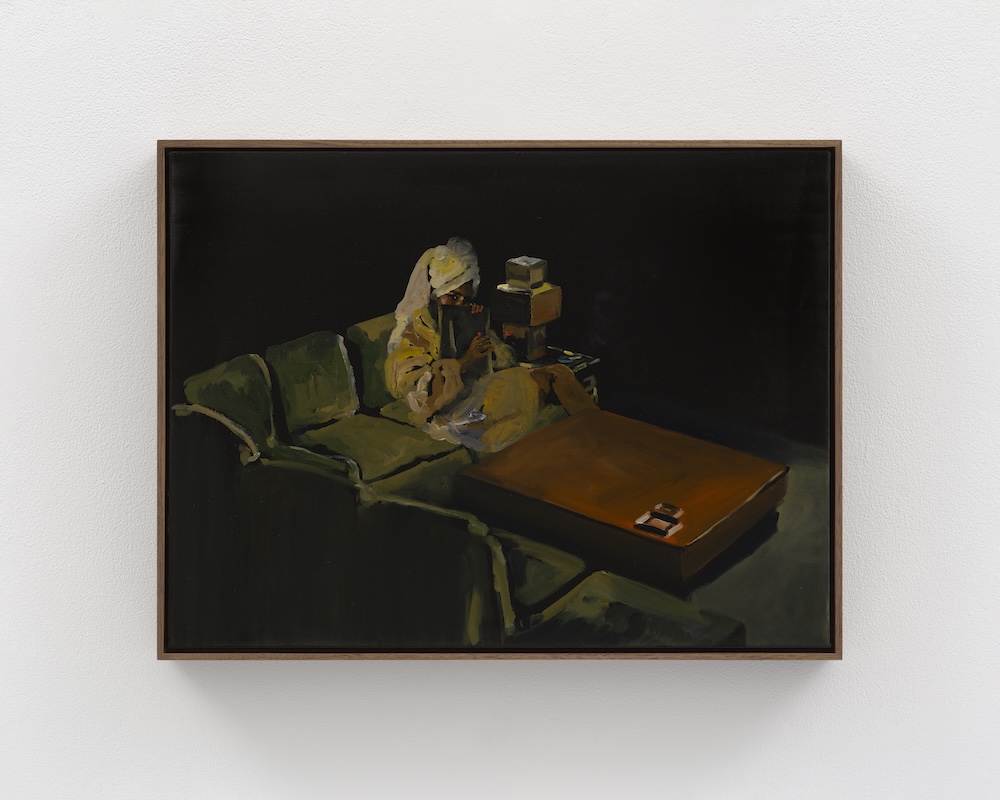
DM: Absolutely. There’s one painting that I feel so guilty about, and it triggers me. It just really triggers me. It’s called Tan Lines. It’s this beautiful Black woman who’s holding a book, and she’s naked and you can see her vulva. She’s totally engrossed in a book. And I’ve been that woman—I think every woman has been that woman!—butt-naked, engrossed in something, and totally oblivious of their complete nudity, right? So I painted that. And I had such guilt. I was like, “Is she going to be seen as a sex object? Like, what is my mama gonna say? What if my daughter sees this?” I still have this guilt around the gaze on the body: how it’s seen; how it’s painted. And I think that is something I struggle with because I don’t want it to be seen as sexual. So I think that painting is a deep trigger for me.
SH: I understand. When I look at your paintings—to your point—I see myself: butt naked, at home with my books, and watching my documentaries (but I’m more of a weed smoker than cigarette smoker). So when I look at these, I think, “Oh, this is truly my intimate world.” But sometimes it’s funny when I read the receptions to your work where it feels like the writers are so surprised by the concepts of it. As if it’s shocking that “Wow, Black women lounge too!”
DM: Yeah, no, it’s become something—even for me as an artist—that’s funny. It has become that, and it has become so many other things. It’s a liberation for the Black woman, but also, for a universal idea of what it means to stop and to be seen, in the most vulnerable moment.
SH: Exactly. Do you have a favorite part of the body to paint? Or a part that you’re always dreading to paint?
DM: I love to paint the breasts of the ladies. And I love to paint their lips. I love to paint their fingernails. I had someone ask me, “Are you okay? Cause these ladies seem to be real to you.” And they are! They are like living beings that I genuinely love. I treat them so tenderly. I love to do their legs—and I never want them to be like these bony, skinny ass legs. I want them to be thick, right? And I show the imperfections because I believe there’s beauty in that. I did a painting earlier on where she's sitting in these striped pants and her breasts, one is big and one is smaller. I was taught never to say things. Like Baldwin says, “you show the story without telling.”
There’s been guilt, because the culture is so sexualized! It’s all big boobs, ass everywhere, BBL! And I wanted to show this woman sitting on a bed with one boob bigger, one boob down. She’s smoking and she’s lost in thought, but she’s completely sexy in her imperfections. And I think that’s where I try to find peace with my own disturbances of what I see in the world.

SH: Okay I’ve been waiting to ask this and now that you’ve brought up the fingernails: what color fingernail polish are you using?
DM: It’s like a crimson red, but then I kind of mix a fluorescent orange in there just to make it really pop! My paintings are really dark, so with red or any kind of color… yellow, green, it is going to pop against that room. It’s like her signature.
SH: Do you wear red fingernails or is this reserved for the ladies?
DM: I started to. I have to admit that the ladies are way more advanced spiritually and emotionally than I am. I was afraid to show my femininity. They have been very great teachers for me because they weren’t afraid to be seen. For example, Tan Lines; she’s laying there, reading her book, and there would be ten people staring at her at that show. I was like, “Oh my God!” So I started adorning myself. I was like, if I can paint this, why can’t I embody that? And so I started painting my own nails that color slowly. But I’m very minimalist. I’m very much the opposite of the ladies. They’re not flamboyant, but they’re very self-assured. And so it’s not something I do all the time. Right now I have a fluorescent pink on.
SH: I am so interested to hear this! You’re right, these paintings embody so much femininity and so much self-assurance. And maybe I wouldn’t even say femininity as much as just womanhood. For me personally, femininity is about adornment, like with nail polish. When we’re talking about mismatched boobie sizes, we’re talking about womanhood: knowing the strength of your body as a woman and all that it has gotten you through. It’s curious to hear… sounds like you have that womanhood down, but femininity is where you struggle?
DM: Are you my therapist? Haha! You told me you were going to go deep. No, it is! I think it is. But I think it’s what makes my painting strong because I’m so vulnerable with it. It’s something I’m tiptoeing around because I want it to be authentic. I don’t want it to be like, “Oh, my nails are red and I wear a bow in my hair and therefore I’m a woman,” I want to feel it in my bones. It goes beyond nail polish. It goes beyond a male validation. It goes beyond if my breasts are imperfect and my vulva is out while reading a book. It’s what I embody in regards to safety and what’s mine. And so I think that that is just the walk of the female. Especially for the Black female—it’s different. The image has been so sexualized or copied. So what does that mean? What does that mean to be looked upon as a Black woman? I think that’s something that I’m wrestling with, but I think that’s what I take to the paint, right? Because even in those moments when my ladies are by themselves and they’re so luxurious, there’s not been a time that someone has said to me, “your ladies are sexy.” And I think what makes them so feminine, they’re not outside sourcing it! You are probably the most beautiful woman I’ve ever seen when you’re sitting there watching your documentary smoking a joint. I guarantee it. That is true femininity, and that’s where I’m trying to be.
SH: Did you always know that your paintings were good? Because I find that people who are good at things are in denial for a long time about their talent.
DM: I’m still in denial. I mean, you can talk to my gallerist, Marianne, right now. Two days ago, I was crying on the phone with her because I’ve been feeling so exposed and like I don’t know what I’m doing. I don’t feel like it’s great. And I look at so many painters—I’m not trained as a painter—that I love that are really painting and really know the process. They know the turpentine mix, blah, blah, blah. And when I go to my studio I think, I just need to paint it black. I need a grid strong image to work from. I need to collage it and just jump into uncertainty. And then something feels good to me… but I’m not good at feeling it.
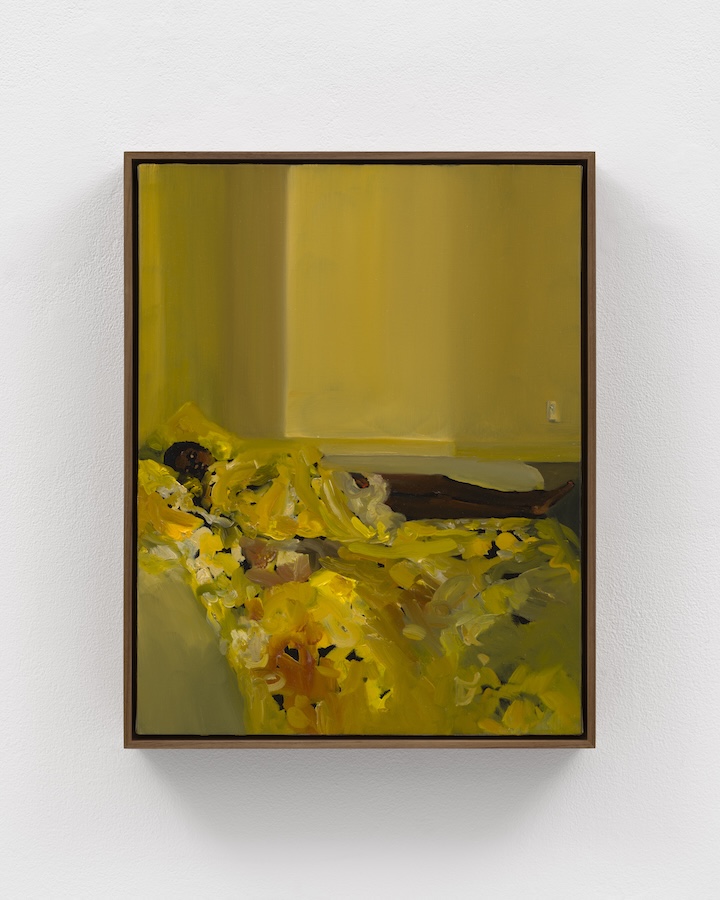
I have this painting called Second Wind, which was stuffed under a box. As I was putting my show together I was like, I have some more paintings, and I showed Marianne, and she was like, “What the hell? What is wrong with you?” I really didn’t believe that it was good. And I’m learning to embrace that, I think that’s what keeps my work real and honest.
" Most artists that I truly love are extreme introverts and they have no idea where the talent came from. And they don’t boast about it."
SH: Mm. I’m sad to hear that but also, you know, it’s so funny, because that is so real. When people are properly talented, it takes them a lot of time to realize that what they’re doing is meaningful and impactful. And good!
DM: Some of the artists that I love so much, like the musicians that I love, say the same thing. They’re just like, “I don’t know what I did.” Most artists that I truly love are extreme introverts and they have no idea where the talent came from. And they don’t boast about it. I mean, look at Frank Ocean. Look at Elizabeth Fraser or Jennifer Packer—one of my favorite artists. She rarely appears. I don’t know, maybe I’m a part of that phenomenon. I don’t know, but I’ve stopped feeling guilty about that insecurity.
I went to Jennifer Packer’s lecture and I was like crying to her. I was like, “I’m so obsessed with you. Can I hang out with you?” And she’s like, “I’m in my own moment right now. I’ll get back with you.” And I totally respected that. There’s a whole tribe out here of introverts. But Jennifer says, “I just paint. If you saw things in my work, great, but I just needed to get it out of my system.”
SH: That’s another thing! There are some artists who are so thoughtful and know exactly what their intentions are. And then there are artists who do exactly what you said; they just go to the canvas and just let it come out. Often the ones that I think are straightforward are actually full of research. And the ones that seem incredibly thought out came from the moment.
DM: Absolutely, and that’s why I stopped feeling guilty. It’s not that I don’t believe in what I do. It’s that I trust the uncertainty now. I trust other people and I trust that if you’re responding to it on a soul deep soul level, then apparently I don’t need to be Caravaggio. Like, just paint. Just keep doing it.
SH: I love what you just said, though, “trust the uncertainty.” Because that is the hardest thing in the world to do.
DM: Of course. It is, it is. But the more you do it, the more practice that you have with it, the more you free yourself, the more you get out of your own way.
At one point I was blocking one of the most beautiful paintings I’ve ever painted. I thought it wasn’t good enough because I smeared a Matisse painting in the background, and the sofa didn’t look too good, and the room looked too brown… but apparently not! People have written the most beautiful letters about seeing themselves as that lady. And I was like, “Okay, what is the lesson here? Maybe the lesson is allowing yourself to trust the uncertainty and put it out there and be vulnerable. And learning to live with that uncomfortable feeling.”
