

BY SALOMÉ GOMEZ-UPEGUI
Women relishing solitude are at the heart of Danielle Mckinney’s enthralling portraits. Surrounded by elegant, dimly lit interiors, they read, smoke, lounge, daydream, and rest. They allow themselves to be. Standing in their presence, one can’t help but feel a longing for moments of such sumptuous simplicity. A photographer turned painter at the height of the coronavirus pandemic, Mckinney has spent the past six years gaining widespread recognition. Her show at the Norton Museum of Art in West Palm Beach, Florida, Danielle Mckinney: Shelter, is her largest institutional exhibition to date. Here, we spoke about her relentless love for painting, the intimacy she develops with the women in her works, and this significant moment in her thriving career.
Salomé Gómez-Upegui: What first drew you to portraiture and women in private moments of solitude?
Danielle Mckinney: It stems from my photographic training. My professors always told me to create a narrative, and I became really intrigued by this idea of placing a woman in a house. When you see a singular female in a domestic space with nothing else around her, it builds a story. We associate home with narrative, emotion, end of the day, quiet time. So it just naturally happened that way through my love for photography and the idea of a portrait telling a story.
SGU: Your pieces convey very specific moods. Do you feel you have to be in a particular mood to paint?
DM: Absolutely. It’s hard for me to paint if I’m not in a good headspace. It’s not that I have to be happy or blissed out; I just have to be in a place where I can enjoy the idea of painting and fall in love with mark-making. What compels me is having a strong foundation to work from. It was the same with my photographic training. When I had a conceptual idea I wanted to execute, that would drive me to get it done. When I have a strong image, like a woman in a home or an interior space, I get drawn in by that. I build the photo around it, and then I have this desire to paint it; I want to get it out. I’ll go through six canvases until that one painting manifests, trying and trying because I’m so intrigued by it.
SGU: And are the scenes autobiographical in any way?
DM: Not necessarily. I use a lot of source material. I’m constantly looking at vintage magazines and old black-and-white interiors from the 1930s and ’40s. I’ll find a space I love, and then I have a whole database of models because I don’t work with live models, and I pull them into the photo and collage it together. They’re not really about me. It’s like when I see my daughter play with her dolls, we set up the house, and it feels completely real. I think I’m doing the same thing.
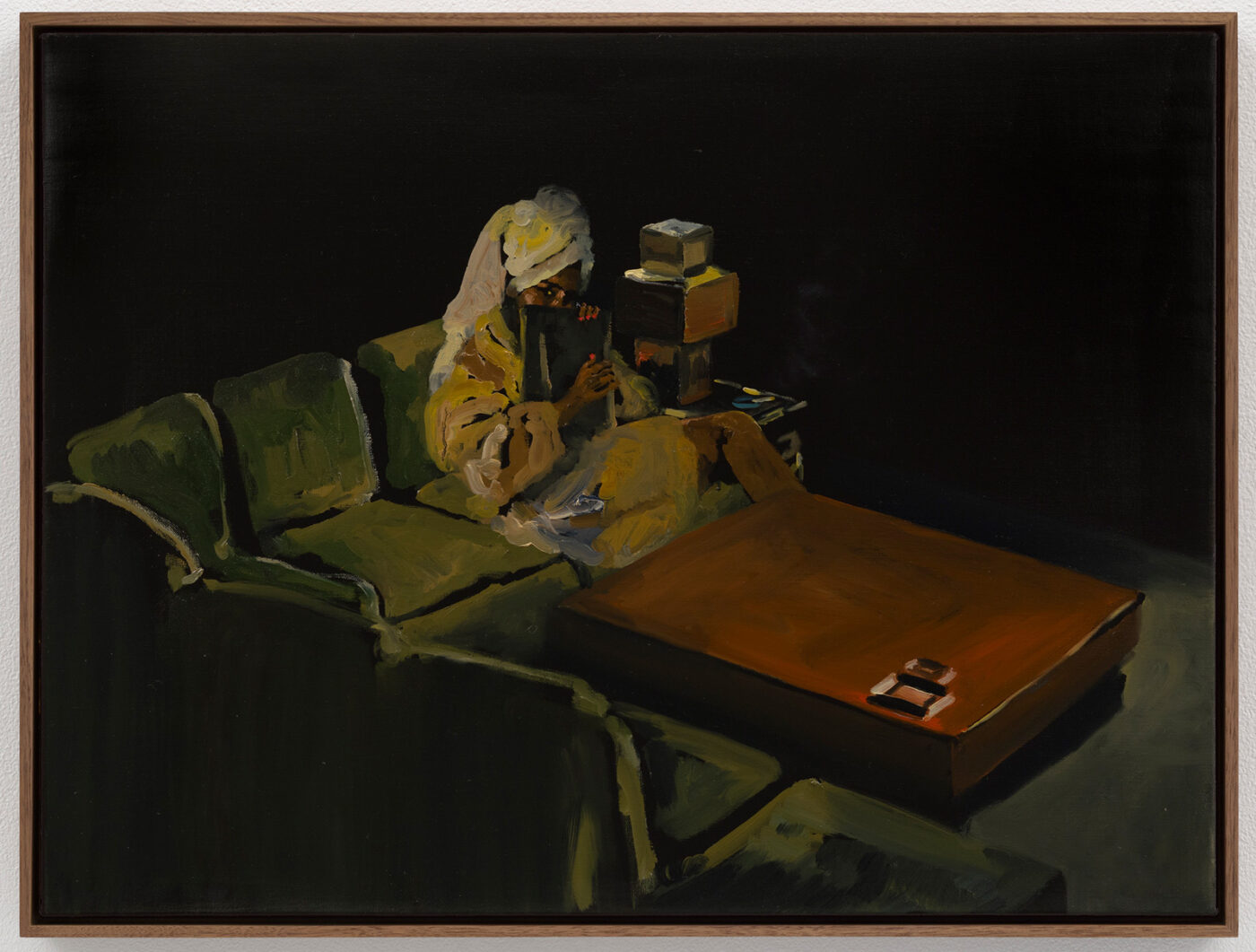
Danielle Mckinney, Read the Room, 2024, oil on linen, 18 × 24 inches. Photo by Pierre Le Hors. Courtesy of the artist, Marianne Boesky Gallery, New York City and Aspen, and Galerie Max Hetzler, Berlin, Paris, London, Marfa. © Danielle Mckinney.
SGU: How much of your source material is fashion related? As much as interiors play a grounding role in your work, it seems fashion does too.
DM: I’m really inspired by fashion. I have an obsession with vintage, 1940s style: the hats, the big fur coats, the silk pajamas, the Japanese robes. I love adorning the ladies in these kinds of pieces, though sometimes they’re nude and just being in their space.
SGU: Do you have a specific ritual for how you show up to your studio? Do you paint every day?
DM: Right now I’m not painting. I finished the Norton show and hit a wall. These paintings came out of pushing hard to get them done, so I wanted to give myself a break. But it’s funny because a week goes by, and all I want to do is paint. I’ll tell myself I’m taking a month off, I’m going hiking, going to the beach with my book, but I wake up with this desire to smell paint and feel it. I know it’s the medium of choice for my spirit. I just want to paint.
SGU: That’s interesting given that solitude and rest are the very subjects you’re conveying on the canvas.
DM: I’m known as the artist who portrays rest, and solitude, and reclaiming that inner space when you get home and close the door, but I don’t take my own medicine. My mom tells me, “Joy, you never sit still; you’re always doing something.” And when I see a finished painting in the studio, I walk by and think, I wish I could just embody a moment like you. So I think she’s a messenger for me as well.
SGU: Can we discuss your interest in tenebrism and this play between darkness and light? What does that approach give you that others don’t?
DM: I think light is just as important as the interior space itself. That’s why I include elements like a lamp or low lighting because it creates a film noir quality and a narrative around seeing and not seeing—a mirage, in a way. A bright fluorescent space can’t be entered in the same way, but a low-lit, soft room creates an atmosphere as lighting becomes an invitation.
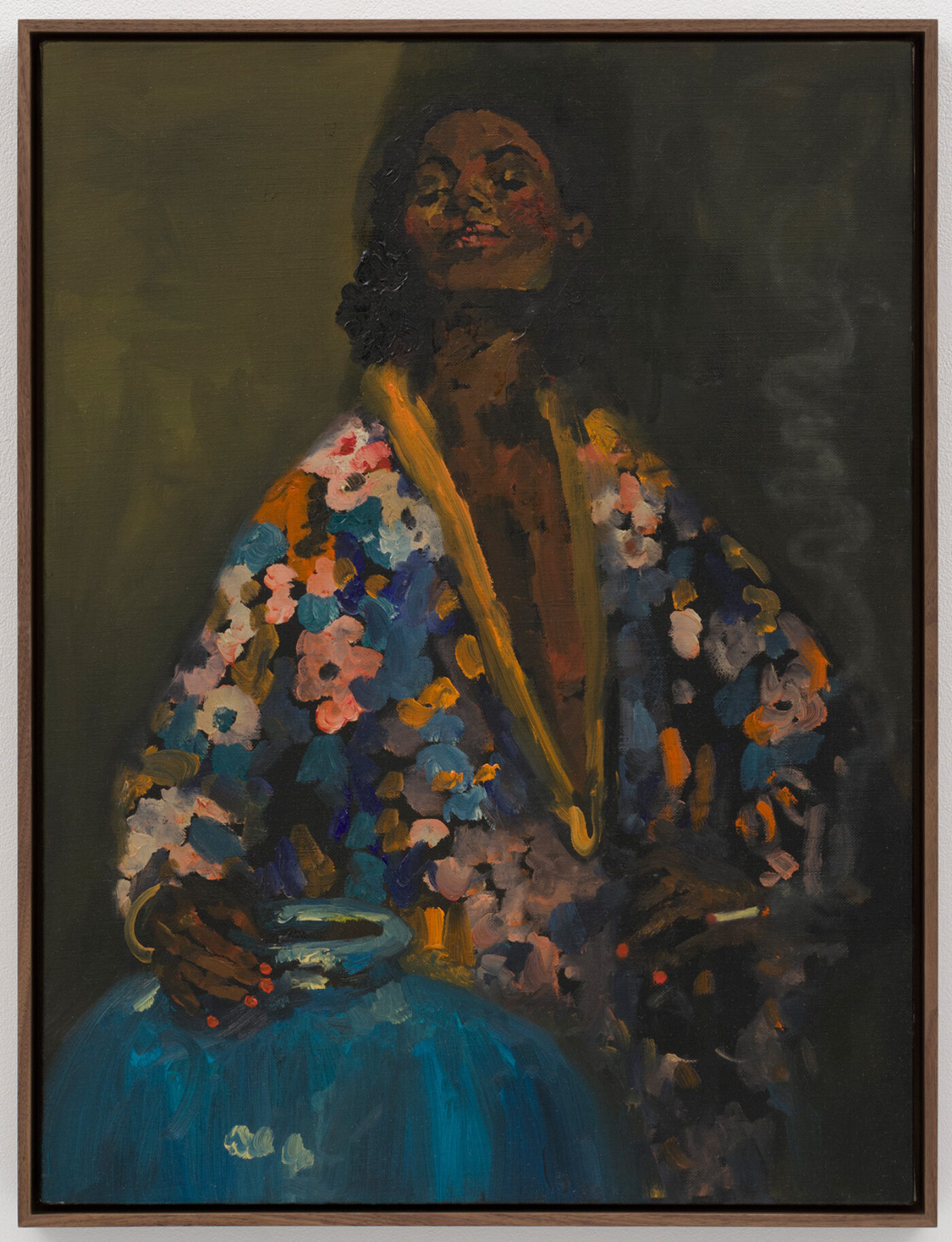
Danielle Mckinney, She, 2023, oil on linen, 24 × 18 inches. Photo by Pierre Le Hors. Courtesy of the artist, Marianne Boesky Gallery, New York City and Aspen, and Galerie Max Hetzler, Berlin, Paris, London, Marfa. © Danielle Mckinney.
SGU: One element that stands out in contrast to all of this is your frequent use of red nails. What symbolic weight do they carry?
DM: I was thinking about this the other day and went back to the very first painting I did with the lady. From the very start, she always had red fingernails. I think it was because I wanted to adorn her and break the intensity. I knew she was resting, but I knew she was carrying something internally, like we all are. There are moments of wit that pull us out of deep intensity, and the red fingernails became a way to adorn her and bring some playfulness.
SGU: You speak of your ladies as specific people. Are you thinking of a person or character when you paint them?
DM: I don’t have a fixed idea of who they are, but they are my ladies. I love them intensely, like my own daughter. Though once they leave the studio, they’re not mine anymore. I’ll go to a collector’s house and see them on the wall, and they’ve become the collector’s ladies. They look at me and remember me as the creator, but they don’t belong to me anymore.
SGU: I read somewhere that you talk to your paintings in the studio. What do you say to them, and do they talk back to you?
DM: Oh, absolutely; it’s maddening. When I’m tired and frustrated, I want her to come, and I know what she should be; I want her to embody a specific mood. I always paint her before I paint the interior, so when I’m talking to them, I’m almost talking to myself. I have this idea that they should really embody the moment, so I’m talking to the painting, like, Please, please let her leg come through; please let me see you. I think that’s always what I’m saying to them: Please let me see you.
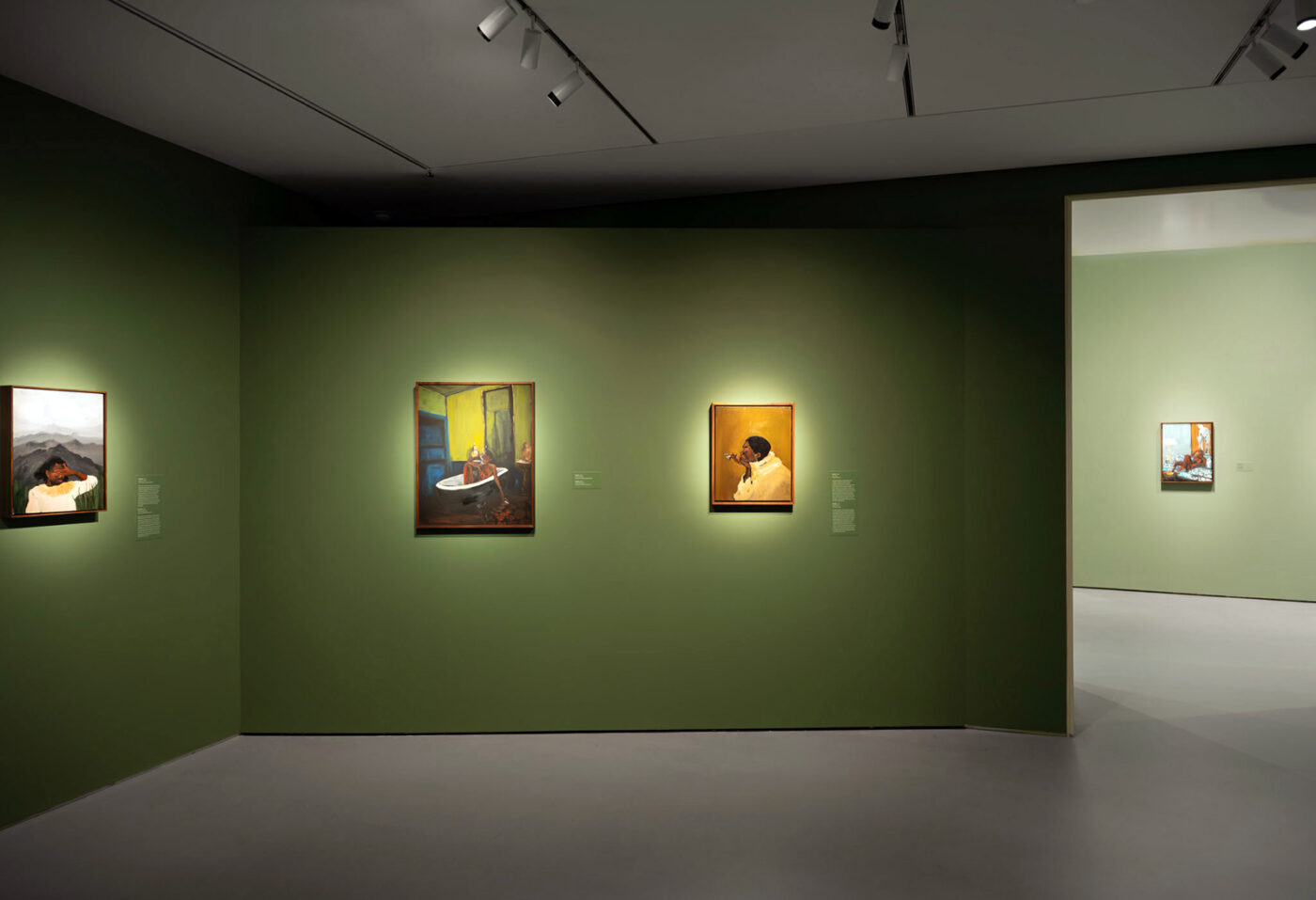
Installation view of Danielle Mckinney: Shelter, 2026. Norton Museum of Art, West Palm Beach, Florida. Photo by Allana Luihn. Courtesy of the Norton Museum of Art.
SGU: Turning to your show at the Norton, it’s your most comprehensive museum show to date. Looking at all of these works together, what realizations have you had about your practice?
DM: I’m extremely grateful. There are artists who never get this moment, so to have it in such a short time has been eye-opening. When I walked in the room, I saw how much the central theme is that woman. I was like, Damn, I’m really obsessed with this lady in the house. But I also realized how much my work has changed and how I’ve given myself permission to let it change. Seeing all the works together, even across different styles, I could see how much they’re in conversation with each other. I’m very critical of myself because I’m not academically trained, but it really helped me to see my work. It gave me permission to trust my practice and to embrace the way I make art.
SGU: How does this moment make you think about the future? Where do you feel your practice wants to go next?
DM: I want to pursue more formal training with painting. Right now, I’m doing old master studies and trying to understand how they work and how to approach the canvas, and I’m looking at the history of abstraction and figurative painting. I’m focusing more on how my practice can evolve. What does it mean if I do large scale? What if I do sculpture? Really allowing this energy inside of me to manifest. And I’m thankful that the work can reach people and inspire them. What keeps me going as an artist is the people who love the work and know nothing about art but can project themselves into it. That gives me more momentum than anything.
