

BY MAXWELL RABB
The Black women who populate Danielle Mckinney’s oil paintings are often found in moments of repose. They may be lounging languorously in a room decorated with flowers, caught mid-thought as they pace around a room, cigarette in hand, or even sleeping. Mckinney manages to capture an uncanny stillness within the inherent messiness of the medium itself. In Shelter (2026), a woman wearing an oversize cream sweater gently rests her chin on her hand, so lost in thought that a butterfly has gently landed on her perfectly manicured hands.
“When we’re really alone by ourselves and nobody’s watching … where do [we] go? What are we thinking?” Mckinney shares on a recent phone call from her studio in Jersey City. “I’m fascinated with it because it shows vulnerability. It shows that I’m not performing for anything. Nothing is capturing my attention, but only myself, and I’m in this moment, and it’s real. It’s human. In the paintings, people can see it, and they become a witness.”
As she talks about bearing witness, it’s not surprising to hear that she began her career as a photographer, but what may be surprising is the fact that she only began painting during the pandemic. The 45-year-old artist was teaching photography at Parsons and picked up painting on a whim after being confronted with quarantine restrictions. Her work quickly found an audience. A year in, she showed her work at Fortnight Institute in New York, Night Gallery in Los Angeles, and Marianne Boesky Gallery in Aspen, and this year she opened another solo exhibition at Boesky in New York (which closed last weekend) and her largest exhibition of work at the Norton Museum of Art in Florida (running through October 9). Photography still plays a part in how she composes her canvases, but it’s the fact that painting does not instantly communicate the emotions she wants to capture that attracts her to the medium.
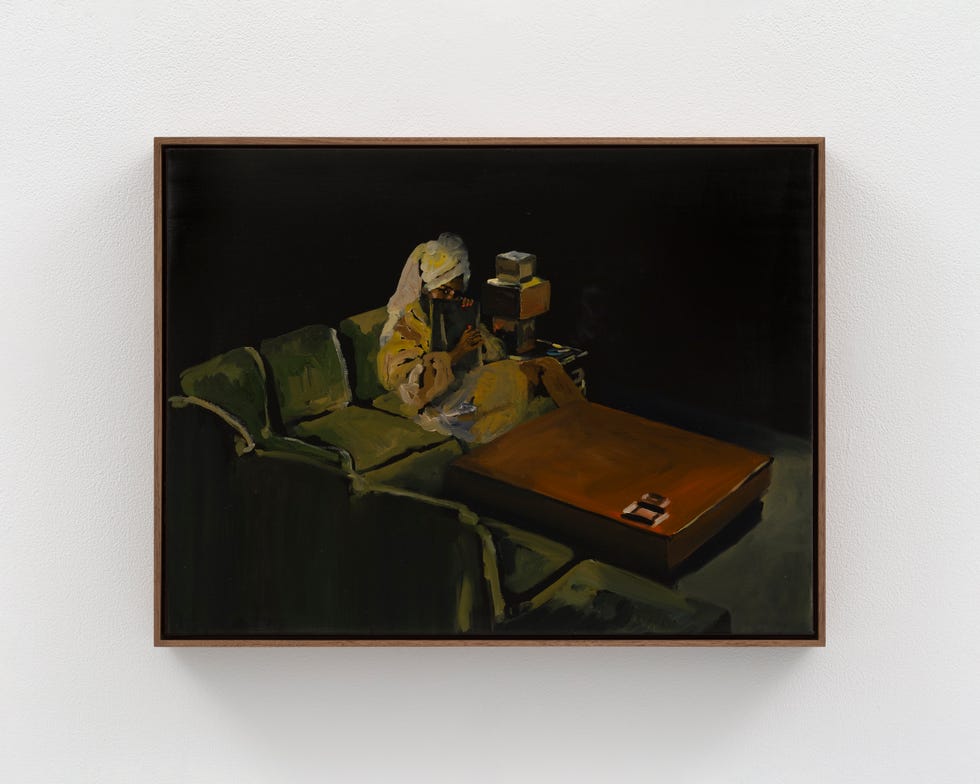
Danielle Mckinney’s Read the Room (2024) at the Norton show
Photo: Pierre Le Hors
“I know what I want, but the paint will never give me what I want,” she says. “That’s the hard part of painting. You can go take a photograph—like Jeff Wall can stage a photograph, and you have it right and click—and it’s done, and you go edit. But with painting, that’s where I’m challenged, and it’s been hard for me.” Mckinney continues, “I want what I have in my head to translate onto the canvas, but I’m always dealing with uncertainty. That’s why I'm obsessed with it, because I’m chasing something that I don't know what it’s going to be. When I paint, it totally comes out to be something that I never planned. I’m constantly gripped by uncertainty.”
But through this uncertainty, she has also grown more confident in her own ideas, as evidenced by the recent switch from acrylic to oil painting. “The brushwork, the way [oil paint] dries, the way it smells, it feels like the alchemy of what paint is,” she explains. “I think that’s when I became confident to say, ‘I trust myself enough to not be perfect, but to experiment.’ That was the turning point in my confidence.”
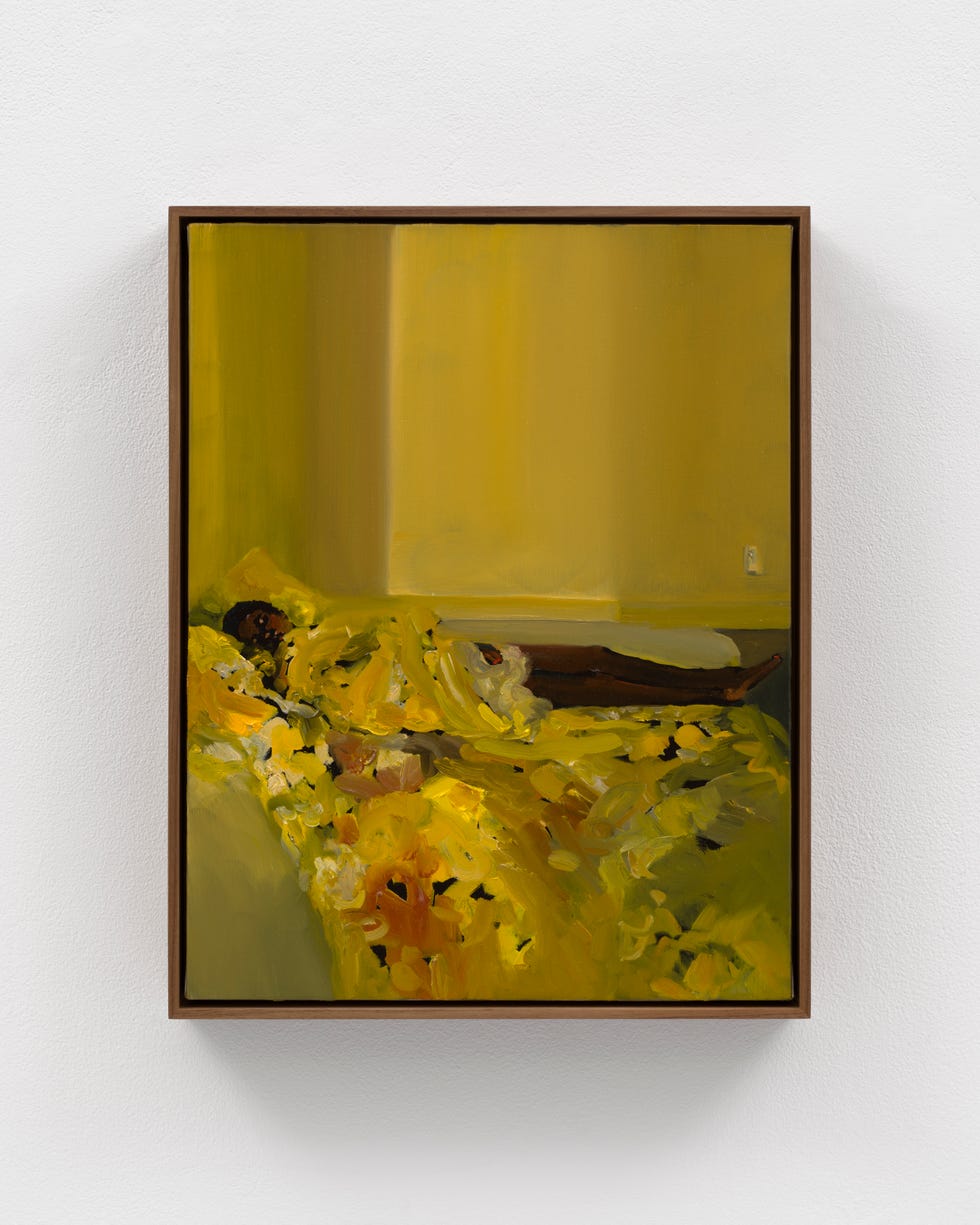
Danielle Mckinney’s Yesterday (2025) at the Norton show
Photo: Pierre Le Hors
And yet Mckinney remains her biggest critic. She often takes down paintings during installation and sometimes has trouble figuring out when she’s finished them. That “uncertainty” that drives her work can exert the biggest pressure, but it also serves as a constant reminder of what she’s trying to achieve. “You’re not trying to be perfect here. Do you love it?” she asks when she’s looking at her canvases. “If I feel it, then I can let it go.”
In her artist’s statement for her Norton show, she declares, “We live in a world where we’re running. There’s beauty in rest.” And yet it’s a feeling that Mckinney sometimes struggles with. “I kept trying to go to the painting, and then when a painting came, I had extreme guilt for painting someone relaxing on a sofa with a cigarette [amid the global turmoil],” she explains. That’s when she decided she hoped to explore the vulnerability that accompanied this creative indecision. “I wanted to express that as an artist, sometimes we have moments in our creative work that are not always perfect, but we somehow move through them.”
What Mckinney asks us to witness is the most vulnerable moments of life, where we feel truly alone with ourselves. Isolation, however, is simultaneously filled with splashes of uncertainty and confidence, occasionally lonely (shut off from the world) yet often comforting (when reveling in one’s own thoughts). After looking back at her first six years of paintings, the artist is finally getting comfortable in her milieu, proclaiming, “I’ve gotten out of my way.”
