

By Ted Loos
The idea of fraternal twins making art together is already unusual, but the Haas Brothers take their partnership to its illogical conclusions — they make fantastical creations that are weird, witty and wild.
Their beaded plantlike forms look like they would be exciting but scary to touch, and their furry, beasty, footed creations seem poised to run away or bite an ankle at any moment. The brothers’ penchant for groan-inducing puns adds to the fun.
Simon and Nikolai Haas have been notable figures on the design scene for some 15 years, despite only being 41. An early commission from Donatella Versace helped jump-start their career in their 20s, and they never looked back.
Their works have always toggled between functional design object and art piece, and many of their creations surf the line between the two, making the categorization debate seem irrelevant.
Now, a midcareer survey of their work, “Haas Brothers: Uncanny Valley,” has just opened at the Museum of Arts and Design in New York. It had a first stop at the Cranbrook Art Museum in Bloomfield Hills, Mich., which organized the show, curated by Laura Mott. After New York it will travel to the Blanton Museum of Art in Austin, Texas, and the Mint Museum in Charlotte, N.C.
“We’re trying to make objects that give you an alternative experience,” said Nikolai, who goes by Niki, as he talked alongside his brother on a video call from their new, 15,000-square-foot studio in North Hollywood, Calif. “If we can just push people this far over, so they can see a whole different world.” Their space is full of plants, and parts of it are painted green, too.
The twins grew up in Austin in an unusually creative household, and their older brother, Lukas Haas, became a well-known actor as a child. Their father worked as a stone carver and painter, and their mother as an opera singer and screenwriter.
“Our household was like a petri dish for creating things,” Simon said. “To come out of our house not doing something like this would have been really weird.”
Credit: The Haas Brothers, via Marianne Boesky Gallery, New York and Aspen
A cast bronze piece with glass beads, this deluxe mushroom might strike a viewer as lamp-shaped, and some makers might have gone all the way and made it a working light fixture — but not the Haases.
“We showed it at Design Miami,” Simon recalled. “The vetting committee almost got us kicked out for that, because it doesn’t have a function. So we called it an umbrella, and then it was allowed to stay in.”
The slightly perverse move of making something almost-functional is a running theme or gag; “She’s So Ducky” (2018), also in the Museum of Arts and Design show, is a velvet-covered carved walnut bench of sorts, and it has two alienlike eyes that stick out and light up, but mostly is “uncomfortable and pointless,” as Simon put it. And they like it that way.
For “Spore,” the Haases worked with a South African beading-art collective called Monkeybiz. “We thought, how can they work from home?” Niki said. “We’ll make a mushroom and they can bead the dots, and we’ll apply them later.” It was the first time they had a group create smaller beaded forms to be assembled into a larger sculpture.
The mushroom also refers to the use and effect of psychedelics. “I think it was sort of our homage to that idea that you can have this really deeply personal experience, but still have it be catalyzed by forces outside of you,” Niki said.
“Fleece-a-Kudrow” (2016)
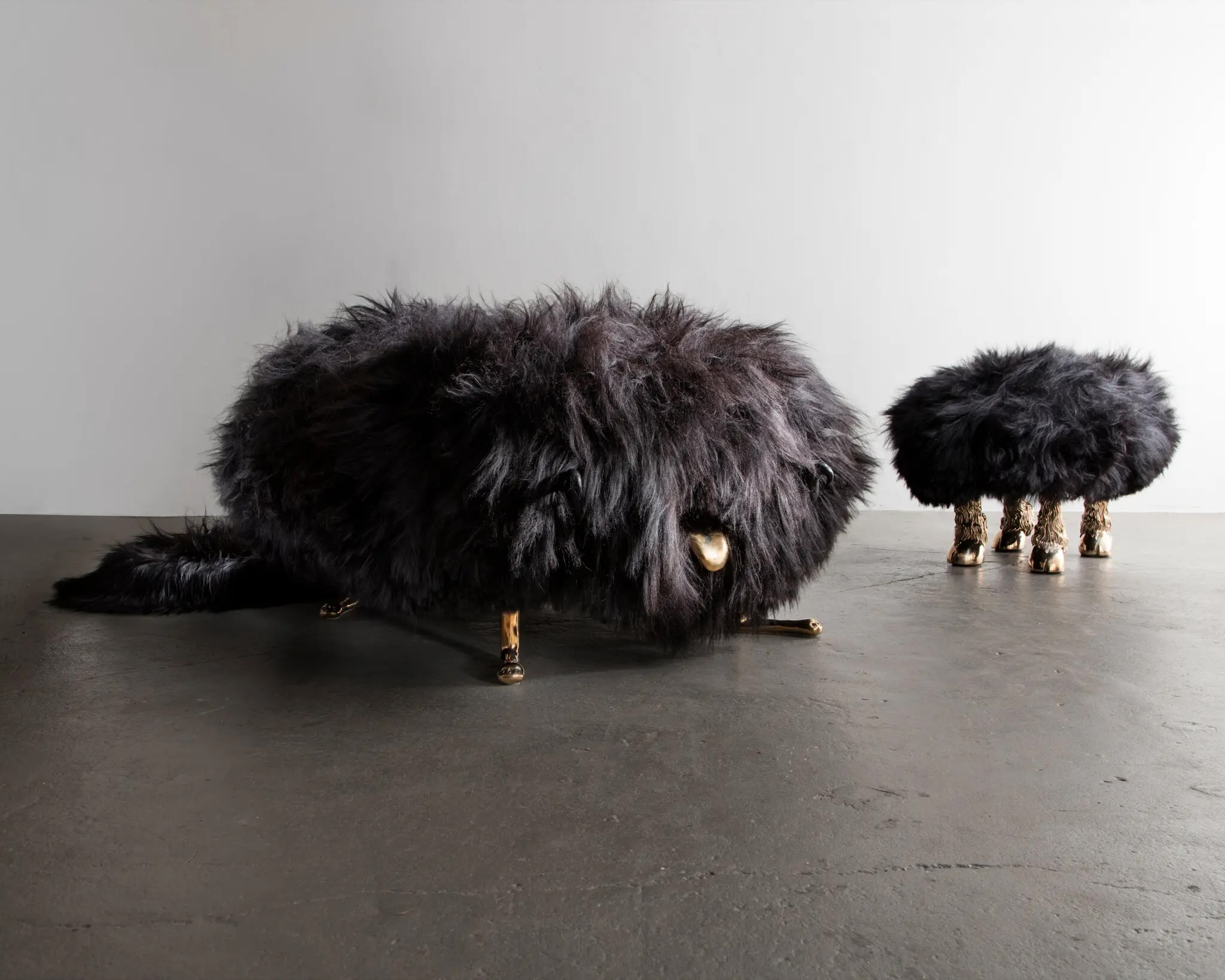
The sheepskin, bronze and ebony ottoman known as “Fleece-a-Kudrow.”
Credit...The Haas Brothers, via Marianne Boesky Gallery, New York and Aspen
No, they don’t know the actress Lisa Kudrow personally. The title of this sheepskin, bronze and ebony ottoman is purely for laughs. “She’s an ottoman and very much a functional thing, but she has a gigantic tail that has no purpose,” Simon said. “It’s almost a wedding dress train, a very luxurious tail.”
The Haases do a lot of anthropomorphizing. “It’s human nature that when you look at an electrical socket, you see a face,” Simon said. “People want to project that onto an object. And in this case, the name gives it a gender, too.”
Although their works are elaborate and suggestive, the brothers also enjoy leaving some conceptual blank space for the viewer.
“The information that you leave out is really important, because it allows the person looking at it to fill it in,” Niki said. “Then the image becomes more intimate in their mind. I think we do that in most of our artwork.”
