

Aubrey Levinthal’s ‘Black Dress’ (2022)
BY ENUMA OKORO
I don’t know about anyone else but for the last couple of weeks I have been thinking about the ongoing challenge of how to be more present in daily life. Such is the turmoil in the world right now that, no matter where one is located, there are enough escalating concerns to give rise to a near constant sense of: “what to do now?”
A few weeks ago, I wrote about trying to hold on to the agency that we do have in our communities and spheres of influence. I imagine I will return to the idea and expand on it in various ways as the months continue. Because I do believe it’s something we need to keep at the forefront of our minds, especially at a time when it can feel like so few good efforts towards justice, compassion or human decency are making a difference in the world. One helpful thing to remember is that we can practise agency at the same time as acknowledging feelings of fatigue or helplessness or concern over what comes next.
I am not one of those writers who has mastered the ability to write solely from an objective point of view when responding to events in the wider world. In fact, more often than not I write into the dark, trying to follow a thread of feeling towards some reflection that might help illuminate something small about this journey we are all on together. I write, I think, in the hope of lighting up just enough room to see where the next step might be. Because that is often all I think is possible.
I am taken by the 2022 painting “Black Dress” by the contemporary American artist Aubrey Levinthal. In this work a woman stands in front of a mirror holding a loose-fitting black dress against her body as though trying to decide if she will wear it that day. The woman’s expression is melancholic, and her skin has an ash-coloured undertone to it. One imagines she might be selecting the dress in recognition of grief or loss. Behind her we can see the window blinds half drawn and daylight coming through. But still, the entire colour palette of the painting appears washed out. A black table fan is visible in the
background. On the dresser beside the woman there are personal items laid somewhat carelessly, without concern for keeping brushes and bottles and sunglasses arranged or in their proper place. The lampshade is also crooked. All of this adds a sense of apathy to the scene. When I look at this painting I see someone doing her best to rise to the occasion
of a new day.
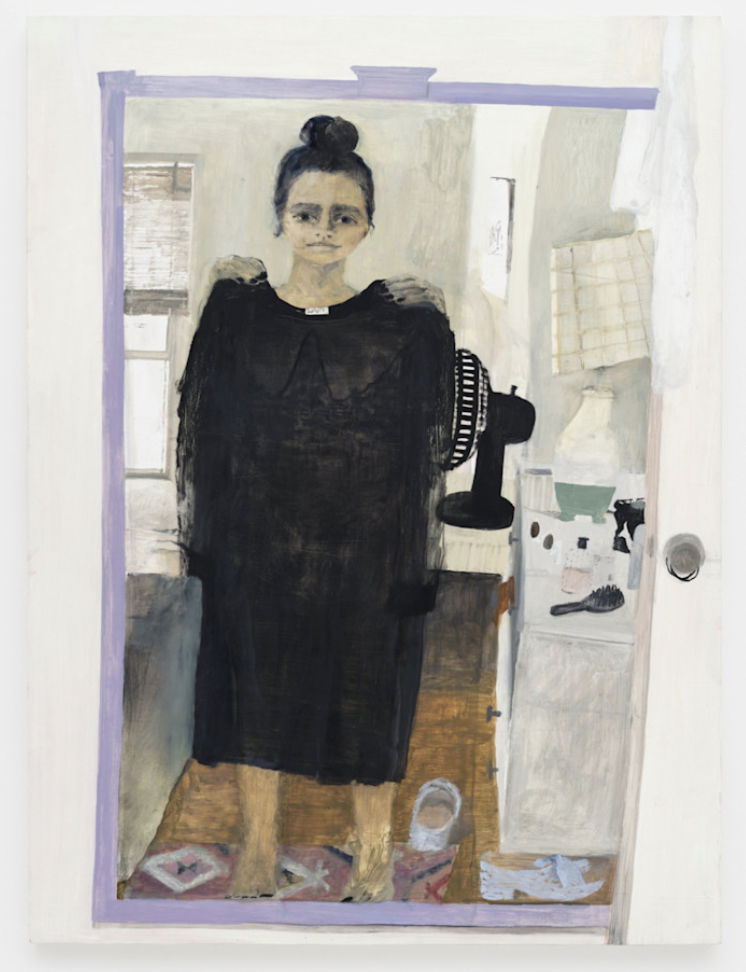
Aubrey Levinthal’s ‘Black Dress’ (2022)
There is no way to know the details of this character’s life but in reflecting on the present state of the world I think about how, often without fully acknowledging it to ourselves or others, we can carry the collective energy of the wider environment. This has a bearing on how we move through the day-to-day of our own lives. The black dress could be symbolic simply of the loss of better times. But what I really like about Levinthal’s painting is that the woman is shown holding up the dress for consideration: is it the right fit? Some days we can stand and adorn ourselves with grief. But some days I think we can stand and question what else might we need to put on to enter the day and into the world. What else might be possible?
In 1918, British landscape artist Paul Nash painted “We Are Making a New World”, a work that is housed at the Imperial War Museum in London. It was based on an ink drawing, “Sunrise, Inverness Copse”, that Nash had sketched the previous year while he was serving on the Western Front. The finished work shows a desolate, almost apocalyptic landscape. Nothing is alive. The trees seemed to have been burnt and their mutilated trunks look like skeletal remains. The muddy earth is scarred by shell craters. And onto this scene of devastation Nash paints a bright white orb of sun with long thin rays extending in all directions.
One imagines the title is symbolic of Nash’s disillusionment. In a moving letter he wrote to his wife from the front lines he said, “It is unspeakable, godless, hopeless. I am no longer an artist interested and curious, I am a messenger who will bring back word from the men who are fighting to those who want the war to go on for ever. Feeble, inarticulate, will be my message, but it will have a bitter truth, and may it burn their lousy souls.”
I was initially reluctant to include this painting because it is so dark and depressing. But the juxtaposition of the title and the work itself reminded me of a powerful quote from a book I read recently, Sage Warrior by the contemporary Sikh American civil rights activist Valarie Kaur. The book was recommended to me by a friend with Sikh roots, and it taught me much about the beautiful Sikh tradition. I found it especially thought-provoking on the subject of how we approach religious, ethnic, racial and other differences. The quote by Kaur that came to my mind while looking at Nash’s painting is: “Not the darkness of the tomb. The darkness of the womb”. I think that the darkness can actually be both. In her book, Kaur describes this era as “the Great Transition — the convulsive birthing labor that precedes the world that is wanting to be born.” I believe all have a part in the labouring, in creating the sort of world we desire for all.
The 1939 painting “Vocation” by Italian magical realist, Felice Casorati, depicts a young naked woman kneeling on a rug in front of a table. Her head and shoulders are slouched over the green tablecloth. Her arms and hands resting on an open book of blank pages. There are other books and sheets of paper laid out on the table. The woman’s eyes are open, but her stare is distant. Except for the wool-like rug, the room appears cold with bare grey concrete walls and a terracotta-like flooring. It was painted during the second world war and just a year before Italy officially entered the conflict.
The title of the painting may seem an odd fit for the work but as a creative myself, as a writer, I can look at this painting and feel a deep resonance. In challenging times, focusing on work can feel like dragging oneself to the foot of the proverbial table. And to make work or perform work that feels meaningful and contributive can be even more difficult. The figure’s nudity seems symbolic to me of showing up willing to completely bear oneself for the sake of trying to make relevant work.
Yet, as I look at this painting and I continue to think about what was happening in Europe during the year it was made, and what is happening around the world today, I keep hearing that line by the author and essayist Toni Morrison that she wrote in a 2015 essay “No Place for Self-Pity, No Room for Fear”. “I am staring out of the window in an extremely dark mood, feeling helpless. Then a friend, a fellow artist, calls . . . he asks, ‘How are you?’ and instead of ‘Oh, fine — and you?’, I blurt out the truth: ‘Not well. Not only am I depressed, I can’t seem to work or write; it’s as though I am paralyzed, unable to write anything . . . I’ve never felt this way before . . . ’ I am about to explain with further detail when he interrupts, shouting: ‘No! No, no, no! This is precisely the time when artists go to work — not when everything is fine, but in times of dread. That’s our job.’”
I am certain I have said this in one of my previous columns because I think about vocation a lot, but the word comes from the Latin vox, which means voice, and vocare, which is to call. I believe that we are all called in some form or other to invest in the good health of our collective humanity. And every day we have to decide whether or not we will show up. This is perhaps especially hard when we are unsure of how to have our voices heard or have our actions make a difference. But we trust that there is a part still for us, as unique individuals with our unique abilities, to lend something towards the healing of a breaking world.
