

BY K.A. LETTS
If there were any doubt that we now live in an age of peak aesthetic pluralism, the exhibition “Uncanny Valley,” at the Cranbrook Art Museum, has thoroughly laid that doubt to rest. The eccentric chairs, benches, vases, lamps and rugs of the Los Angeles-based twin brothers Nikolai and Simon Haas live at the intersection of lowbrow mass culture and highbrow fine art. The brothers’ aggressively accessible work will be instantly comprehensible to contemporary audiences while at the same time eliciting the uneasiness referenced in the exhibition’s title.
The term uncanny valley refers to a psychological theory hypothesizing that the closer an inanimate object comes to resembling a human being, the more disturbing that resemblance becomes. The idea is particularly applicable to new technologies like 3D computer animation and artificial intelligence and is relevant to the work of the Haas brothers as a loose analogy to the uneasiness the exhibition may produce in gallery visitors. In this instance, the “uncanny valley” is the queasy feeling engendered when pop-adjacent artworks are presented as fine art. The artists openly—even gleefully–borrow imagery from animations like the television show “Futurama,” among other mass market cultural products, to create work that is easily grasped by the general public, yet difficult to define taxonomically in art world terms.
The main gallery is devoted to a number of quasi-installations that elide the difference between architectural furnishings, taxidermized representations of unknown animal species and sculpture. The impressively crafted chairs, lamps, benches and other objects often combine luxurious materials, such as art glass, marble, fine wood and bronze, with fake fur, polyurethane and light bulbs. The resulting embodied critters are intentionally silly, sexy and disarming while suggesting a subversive, slightly sinister undercurrent.
The titles of the pieces are relentlessly punning, sometimes profane and often named after celebrities. Thus, we get Needle Juice and Hugs Bunny, Titty Slickers and Mary Tyler Spore. The jokey (and occasionally smutty) labels are good for a chuckle as we stroll through the galleries.
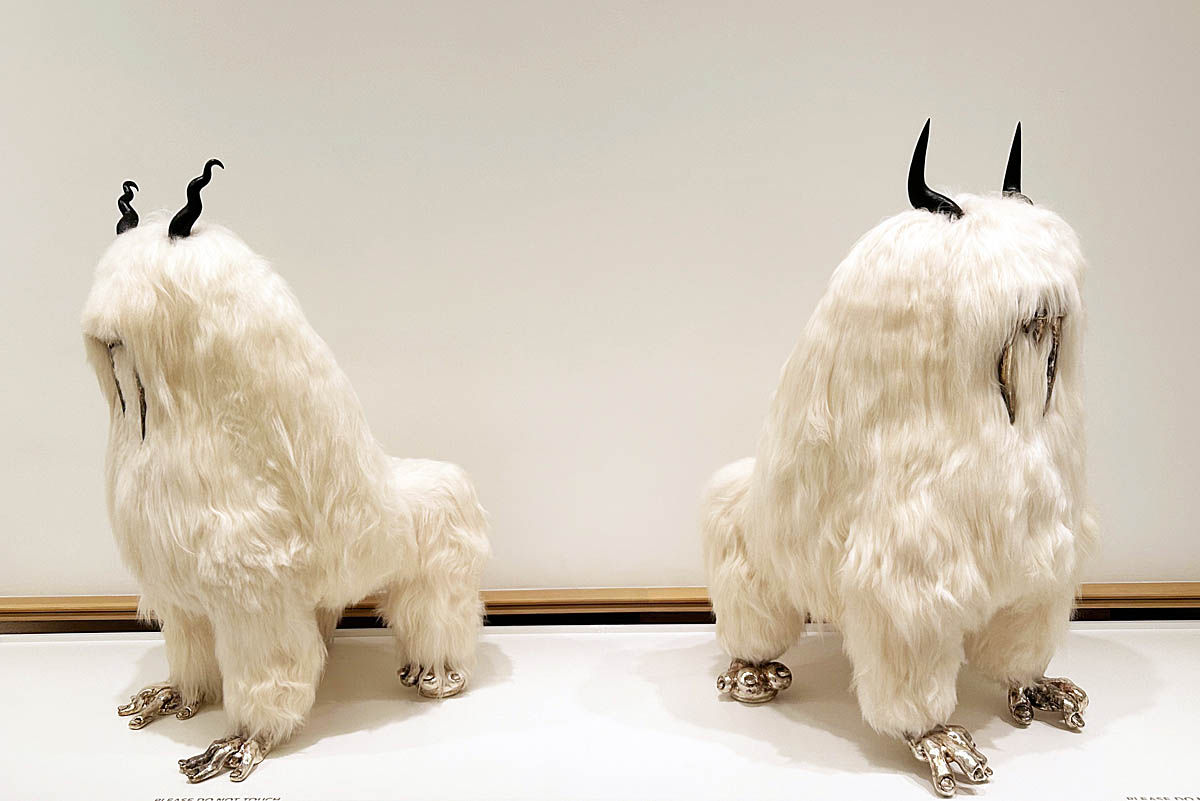 Jean Luc Pi-guard, 2016, (r.)Brooke Shield, 2016, Icelandic sheepskin, silver-plated bronze, hand carved ebo
As we enter the main gallery, two enormous, yeti-like beings hulk along the wall, their sharp, ebony horns and silver-plated claws contrasting with their cozy white fur. Jean Luc Pi-guard and Brooke Shield (as they are called) imply both friendliness and lethality. Other artworks, like the lamp James Pearl Jones and the bench and table set Bend Affleck & Giraffe-ael Warnock, show off the artists’ skills as wood and stone carvers. Nearby, an enormous black, horned and fanged creature, King Dong, sits atop a low pedestal and towers over a collection of smaller furry and fantastical figures.
 “Uncanny Valley,” installation (with King Dong), Cranbrook Art Museum
The museum’s side gallery holds yet more denizens of the Haas brothers’ fertile imagination. Working in cooperation with craft collectives in South Africa and California, they have fabricated a group of intricately beaded creatures and one mighty, exotic tree. One of the most amusing and conceptually satisfying collections in this section is a series of smallish wool rugs that represent mostly extinct animals, their flatness calling to mind roadkill. Cheetah Hayworth, LaBrea Brad Pitt, Quasidodo, and Taz Been represent (respectively) a flattened cheetah, a deceased mastodon, an extinct dodo and an expired Tasmanian devil. Just outside the gallery doorway, computer-generated “paintings” show backlit landscapes that capture the twilit sweep of costal California, framed by freeform, fleshy pink polyurethane surrounds.
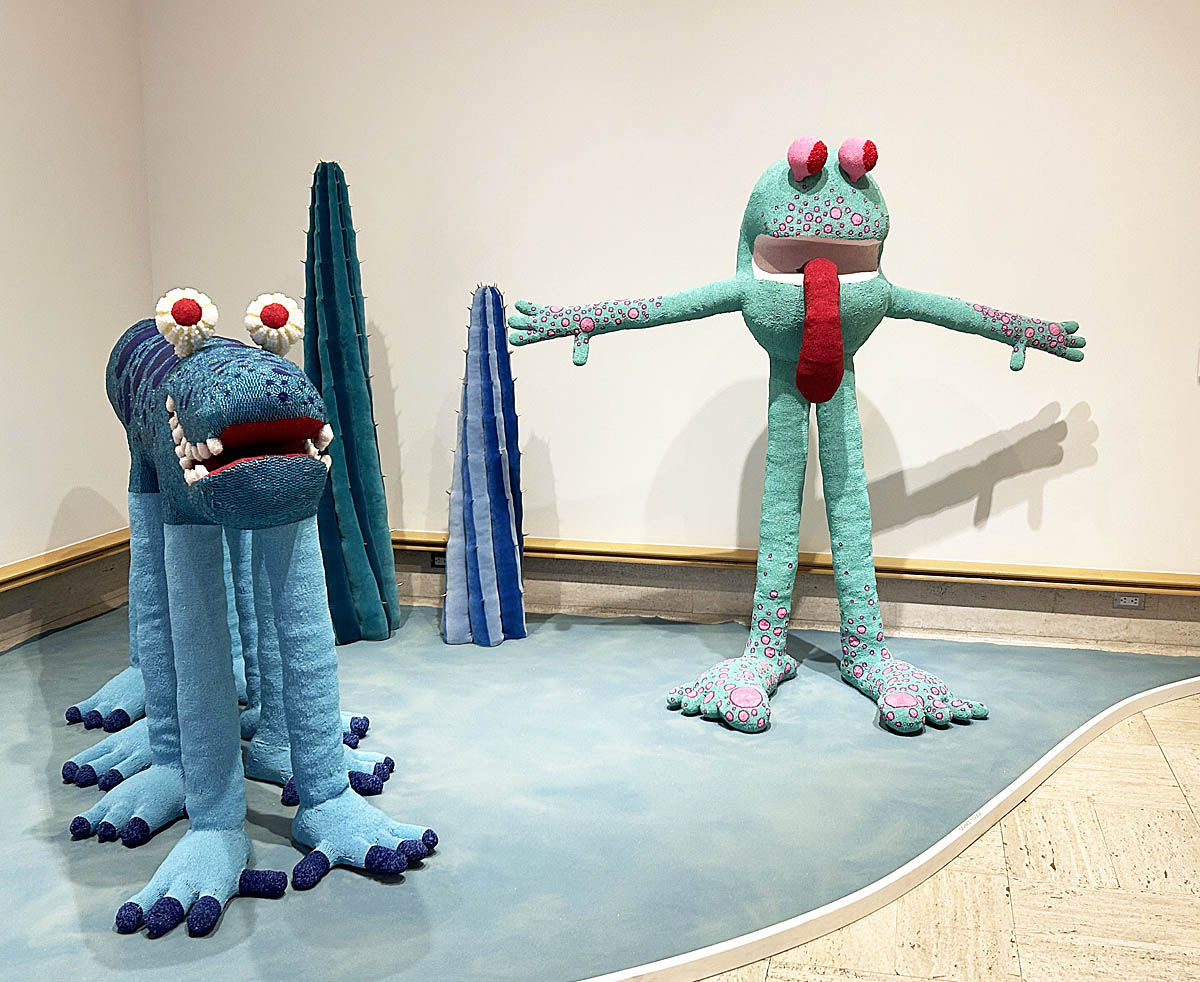 (foreground l. to r.) Gator Tots, 2019; Mouth-ew-Broderick, 2019, glass beads, wire, mixed fiber stuffing, (background l. to r.) Needle Juice, 2018; Thorn Hub, 2018, velvet, brass, poly-fil fiber
Some art scolds might question the status of the work in “Uncanny Valley” as fine art, but the impressive craftsmanship, luxe materials and large scale of many objects in the collection argue persuasively that the Haas’s artworks are indeed museum worthy. In this age of aesthetic flux, it may not pay to be overly dogmatic, and we might benefit by letting go of pre-conceived ideas in favor of a more experimental—and playful–approach to art. Perhaps we don’t need to insist on identifying these artworks as either kitschy toys or rarified cultural objects of lasting value, but can say “yes” to it all.
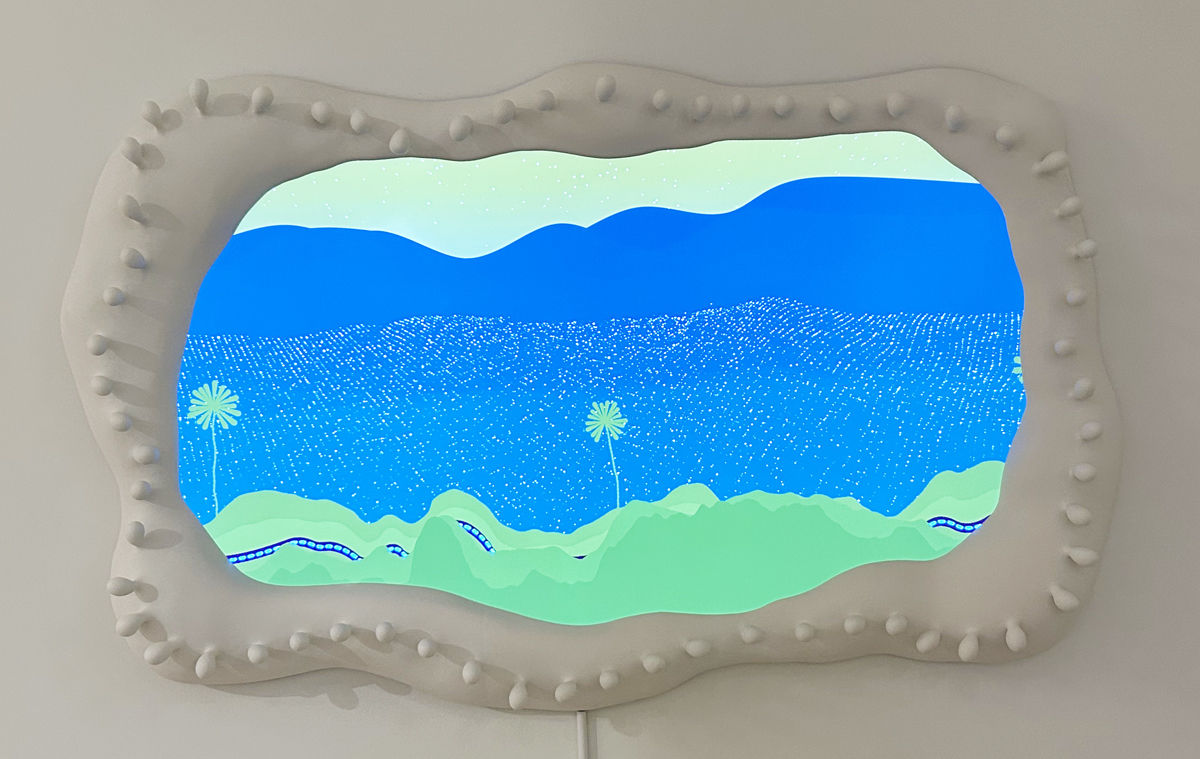 Mulholland, 2023, Java drawing program, QLED screen, 3-d printed ABS, polyurethane, enamel
The exhibition was organized by the museum’s Chief Curator Laura Mott, with the assistance of Katy Kim, Jeanne and Ralph Graham Curatorial Fellow. “Uncanny Valley” will be traveling to other museum venues throughout the U.S. in 2026. A 256 -page catalog of this midcareer retrospective of the Haas brothers’ work is available for sale at the museum.
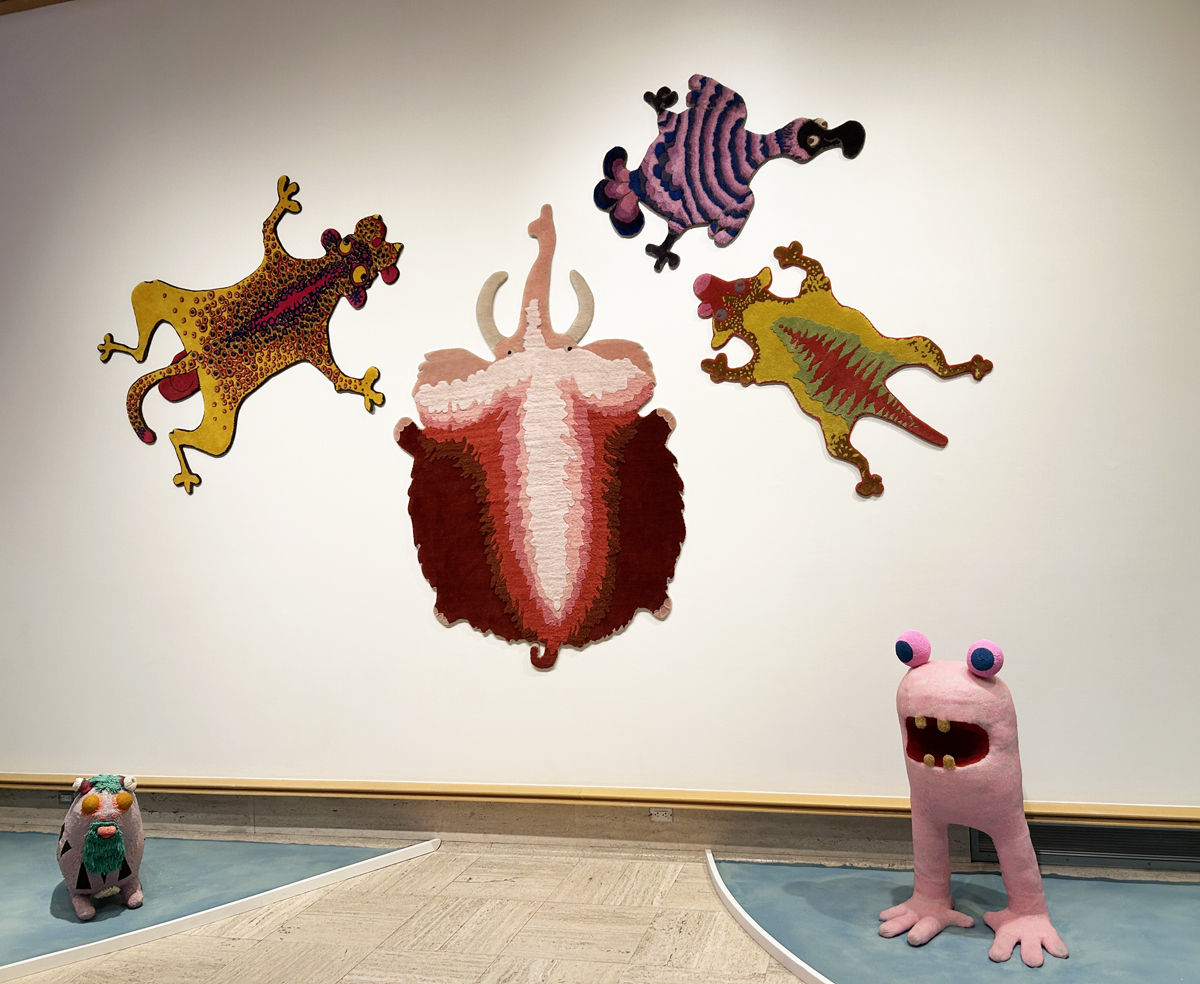 (from left) Cheetah Hayworth, LaBrea Brad Pitt, Quasidodo, Taz Been, 2017, wool rugs